'The New World of Work' a joint event of Horizon Europe sister projects
On 6 May 2026, we had the pleasure of co-organising an international online webinar event dedicated to the future of platform work, workers’ rights, and the implementation of the EU Platform Work Directive. The webinar was created within the collaboration of three sister Horizon Europe projects: FUTOURWORK, EGRUiEN and INTEGRATE-DIALOGUE - all focusing on related challenges connected to the transformation of work, social dialogue, and labour conditions in the platform economy.
The link to the recording can be found here
The event brought together researchers, representatives of partner organisations, and trade union representatives from across Europe, creating a valuable space for exchanging experiences and discussing the challenges linked to the changing world of work.The agenda included:
 opening remarks by Silvia Rainone (ETUI) who reflected on the ETUI EU Platform Work Directive policy brief. Silvia has shared key headlines and her perspective on why understanding the Directive matters so much right now for its implementation;
 an analysis of changes in Vienna’s on-demand transport sector has been presented by Dr. Elif Naz Kayran and Nikko Bilitza (EuroCentre) from the EGRUiEN project. The presentation focused on the arrival in Vienna of Uber. The company clashed with existing local actors in the on-demand transport sector. EGRUiEN’s study examines how the city’s institutions responded to this disruption, namely the bargaining process and settlement which re-embedded platform services within the existing regulatory system. The settlement’s unstable nature shows how integrating platforms into economies built around traditional labour relations is a contested and ongoing process, shaped by shifting power and institutional dynamics;
a discussion on precarity and social dialogue in tourism and hospitality was presented by Michela Trentin (University of Westminster) from the FUTOURWORK’s project focusing on qualitative research with hotel managers, NGOs, workers, employers’ organisations, and trade union representatives. The findings reveals a dual landscape regarding digitalisation in tourism and hospitality. On one hand, stakeholders highlight how digital tools can enhance work processes when workers are meaningfully involved through co‑decision and the ability to contest technological change. On the other, organisers of hospitality workers emphasise how digitalisation often reinforces the sector’s longstanding precarity, even as hospitality appears less exposed to full-scale “Uberisation” or algorithmic management. With a focus on wellbeing and worker voice, Michela's presentation has examined the limits and possibilities of the digital promise and has explored what a more inclusive model of social dialogue could entail;
 legal challenges and needs of non-standard workers was presented by Natalie Videbæk Munkholm (University of Southern Denmark) who has showed what are the needs, interests, and motivations of non-standard workers in engaging with social dialogue. She has asked also what is the capacity and willingness of social partners to integrate these workers into existing dialogue structures? The INTEGRATE-DIALOGUE’s presentation has explored these questions and shared research on how EU-level legal frameworks interact with national social dialogue systems in five different countries – Norway, Denmark, the Netherlands, Italy and the UK;
reflections on the Foodora Norway collective agreement.
We ended our webinar with the reflections from Foodora Norway provided by the trade union representative Philip Rein who reflected on the experience organising bike couriers in Norway and reaching one of the first successful collective agreements with a food delivery platform company. He has shared lessons learned from this landmark case.
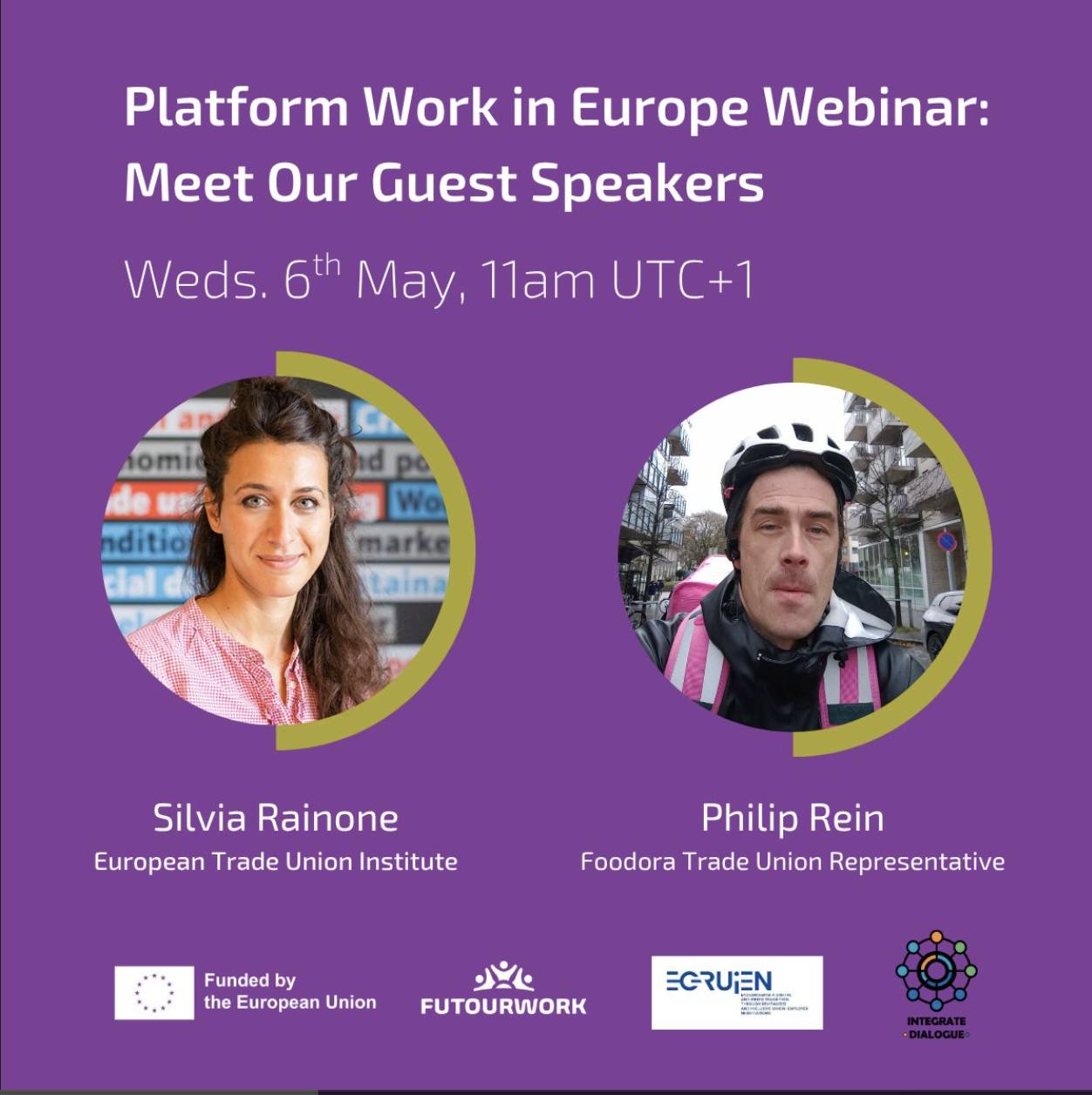
Thank you to all speakers and participants for the inspiring discussions and active engagement during the Q&A session. Cooperation between Horizon Europe projects shows the importance of combining research perspectives, practical experiences, and social dialogue to help shape a fairer and more inclusive future of work in Europe. Looking forward to future webinars, seminars, and insightful discussions.
Event graphics prepared by the FUTOURWORK.