EGRUiEN project present at the 17th Conference of the European Sociological Association
The EGRUiEN project members were present at the 17th ESA Congress "Strengthening Democracies: Social Action, Solidarity, and Sustainable Futures" held in Warsaw on 25-28th of August 2026.
Jacek Burski, Adam Mrozowicki and Szymon Pilch from the University of Wrocław were presenting the preliminary findings from WP3 and WP4 focused on the social dialogue and green and digital transitions in Stellantis Poland (automotive sector) and state-controlled PGE (Polska Grupa Energetyczna) and PGG (Polska Grupa Górnicza) (energy sector, lignite and hard coal mining industries).
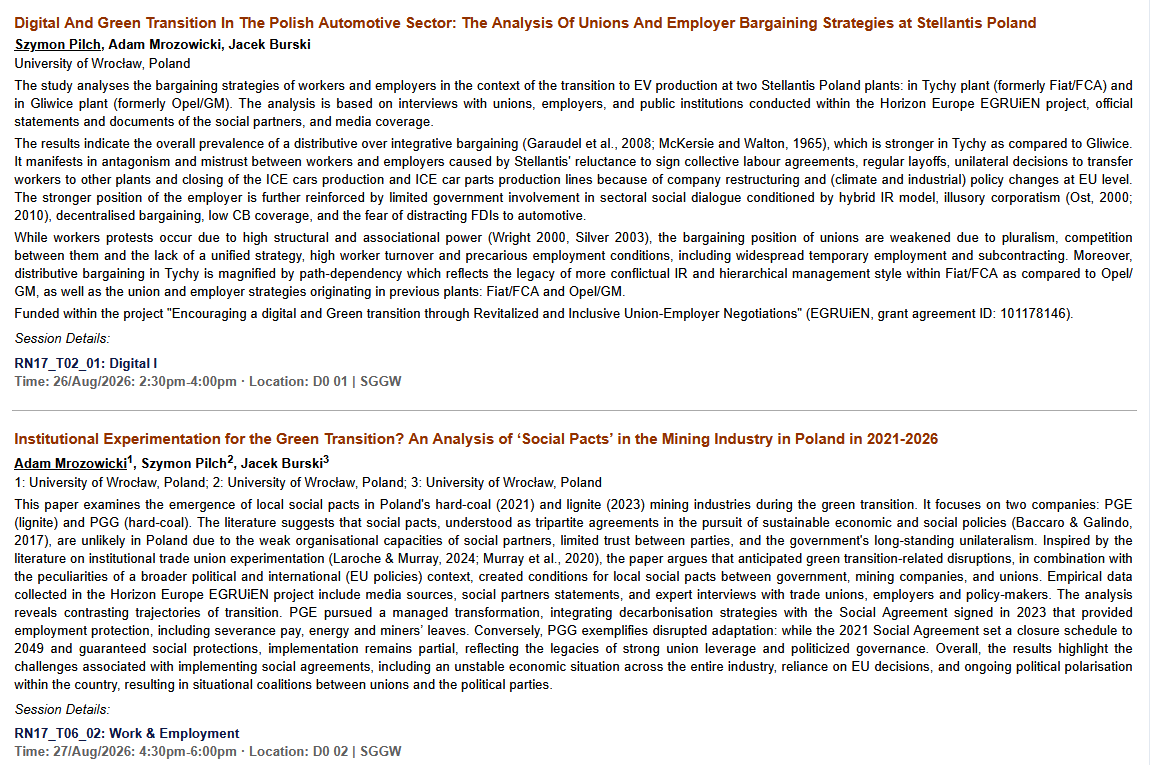
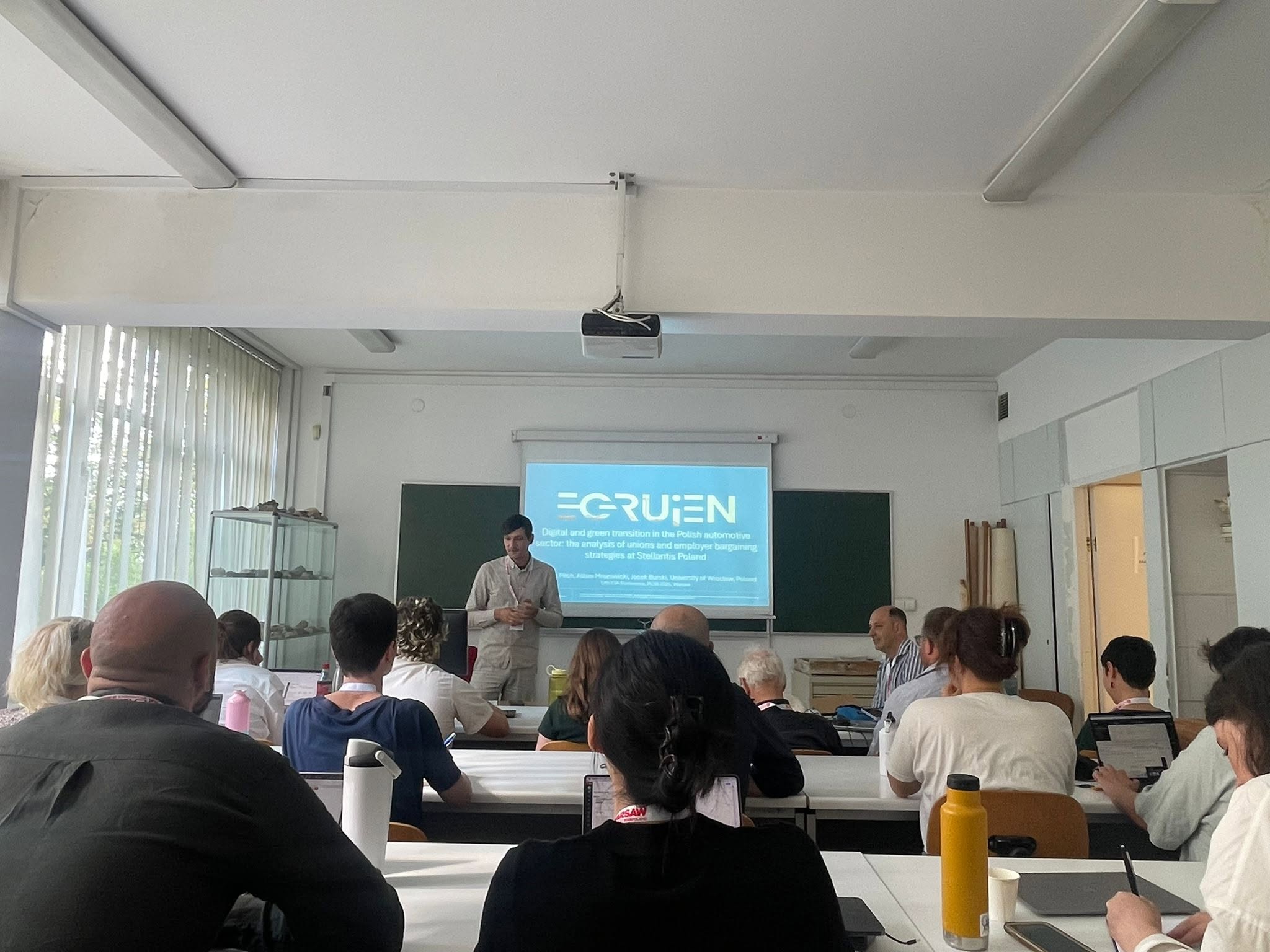
The first paper "Digital And Green Transition In The Polish Automotive Sector: The Analysis Of Unions And Employer Bargaining Strategies at Stellantis Poland" presented analyses of the bargaining strategies of workers and employers in the context of the transition to EV production at two Stellantis Poland plants: in Tychy plant (formerly Fiat/FCA) and in Gliwice plant (formerly Opel/GM). The analysis has been based on interviews with unions, employers, and public institutions conducted within the Horizon Europe EGRUiEN project, official statements and documents of the social partners, and media coverage.
The results indicate the overall prevalence of a distributive over integrative bargaining (Garaudel et al., 2008; McKersie and Walton, 1965), which is stronger in Tychy as compared to Gliwice. It manifests in antagonism and mistrust between workers and employers caused by Stellantis' reluctance to sign collective labour agreements, regular layoffs, unilateral decisions to transfer workers to other plants and closing of the ICE cars production and ICE car parts production lines because of company restructuring and (climate and industrial) policy changes at EU level. The stronger position of the employer is further reinforced by limited government involvement in sectoral social dialogue conditioned by hybrid IR model, illusory corporatism (Ost, 2000; 2010), decentralised bargaining, low CB coverage, and the fear of distracting FDIs to automotive.
While workers protests occur due to high structural and associational power (Wright 2000, Silver 2003), the bargaining position of unions are weakened due to pluralism, competition between them and the lack of a unified strategy, high worker turnover and precarious employment conditions, including widespread temporary employment and subcontracting. Moreover, distributive bargaining in Tychy is magnified by path-dependency which reflects the legacy of more conflictual IR and hierarchical management style within Fiat/FCA as compared to Opel/GM, as well as the union and employer strategies originating in previous plants: Fiat/FCA and Opel/GM.
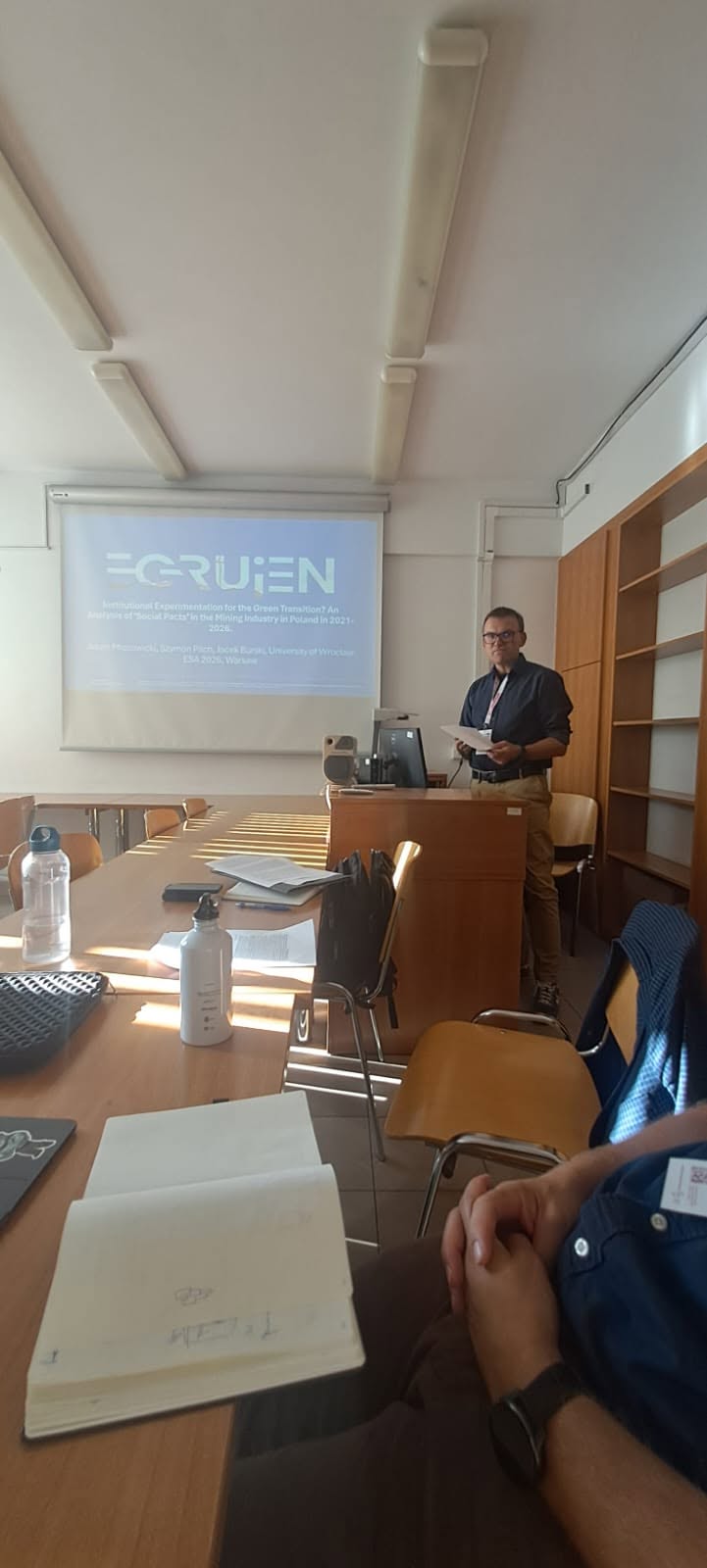
The second presentation, "Institutional Experimentation for the Green Transition? An Analysis of ‘Social Pacts’ in the Mining Industry in Poland in 2021-2026", examined the emergence of local social pacts in Poland's hard-coal (2021) and lignite (2023) mining industries during the green transition. It focuses on two companies: PGE (lignite) and PGG (hard-coal). The literature suggests that social pacts, understood as tripartite agreements in the pursuit of sustainable economic and social policies (Baccaro & Galindo, 2017), are unlikely in Poland due to the weak organisational capacities of social partners, limited trust between parties, and the government's long-standing unilateralism. Inspired by the literature on institutional trade union experimentation (Laroche & Murray, 2024; Murray et al., 2020), the paper argues that anticipated green transition-related disruptions, in combination with the peculiarities of a broader political and international (EU policies) context, created conditions for local social pacts between government, mining companies, and unions. Empirical data collected in the Horizon Europe EGRUiEN project include media sources, social partners statements, and expert interviews with trade unions, employers and policy-makers. The analysis reveals contrasting trajectories of transition. PGE pursued a managed transformation, integrating decarbonisation strategies with the Social Agreement signed in 2023 that provided employment protection, including severance pay, energy and miners’ leaves. Conversely, PGG exemplifies disrupted adaptation: while the 2021 Social Agreement set a closure schedule to 2049 and guaranteed social protections, implementation remains partial, reflecting the legacies of strong union leverage and politicized governance. Overall, the results highlight the challenges associated with implementing social agreements, including an unstable economic situation across the entire industry, reliance on EU decisions, and ongoing political polarisation within the country, resulting in situational coalitions between unions and the political parties.